Intelligent Data Foundations for Scalable Insights

Intelligent Data Foundations for Scalable Insights

A solution designed to modernize and scale data infrastructure, unlocking better decisions across the organization.

As companies grow, so does the complexity of their data. Fragmented sources, inconsistent pipelines, and legacy systems often lead to slow, manual reporting and limited visibility. This solution was created to solve that challenge—by establishing strong, AI-enabled data foundations built for scale.

The challenge
Many organizations operate with outdated or incomplete data ecosystems, making it difficult to extract value from their data. Teams waste time managing fragmented datasets, face reporting inconsistencies, and lack the agility to adapt their data systems to new business needs.

The solution
This solution delivers a three-step approach to modern data architecture:

  • Assessment of current infrastructure: A technical and functional evaluation identifies inefficiencies, bottlenecks, and missed opportunities.
  • Implementation of cloud-native data platforms: A centralized Data Lake and a serverless Data Warehouse on Amazon Redshift provide scalable, secure storage and analytics capabilities.
  • AI-driven data classification: Using Amazon SageMaker, the solution deploys a machine learning model to classify and organize supplier data, enabling better purchasing decisions and vendor management.

The architecture
Built entirely on AWS, the solution includes:

  • Amazon S3 and AWS Glue for data lake storage and preparation
  • Amazon Redshift Serverless for fast, scalable querying
  • Amazon SageMaker for custom model training and deployment
  • AWS Lambda and Step Functions for automated workflows

The results

  • 360° data visibility across departments
  • Up to 50% reduction in time spent preparing and querying data
  • Smarter decision-making through AI-enabled supplier insights
  • A flexible, future-proof architecture ready for advanced analytics and AI

By combining cloud scalability with machine learning, this solution transforms data into a strategic asset—no matter the size or industry.

Industry Challenge

Water utilities are under pressure to maintain aging underground infrastructure while minimizing service disruptions and damage claims. Traditional leak detection methods are reactive, labor-intensive, and often fail to catch critical failures in time. As costs rise and resources remain limited, there’s a growing need for smarter, more proactive infrastructure management.

Key challenges include:

  • Missed early warning signs of pipe rupture
  • Rising costs due to property damage claims (fincas)
  • Manual prioritization and dispatching
  • Lack of structured guidance for field crews

The Solution: Intelligent Leak Prediction & Field Optimization by DinoCloud on AWS

DinoCloud’s solution uses advanced AI and machine learning to anticipate pipe ruptures and optimize operational response. Built on Amazon Web Services (AWS), the system combines predictive analytics, proactive alerting, and real-time field feedback to deliver a closed-loop leak management workflow.

AI-Powered Capabilities

🔮 Predictive Model for Pipe Failures
At the core is a machine learning model (XGBoost) trained on infrastructure, environmental, and historical leak data. It identifies pipes at high risk of rupture and automatically generates a prioritized list of potential leaks based on criticality.

📊 Proactive Alerting & Claim Prioritization
The AI system issues alerts to operations teams, focusing attention on the most urgent issues. This allows preventive interventions that reduce property damage and shorten response times.

👷 Field Crew Optimization & Guidance
The system recommends where to send crews based on model outputs. Once in the field, crews use a digital checklist of AI-generated steps tailored to each case, helping them detect invisible leaks and standardize resolution efforts.

🔁 Feedback Loop for Continuous Improvement
After inspections, crews report outcomes (e.g., “leak confirmed” or “false positive”). This feedback feeds into the model’s learning cycle, improving future prediction accuracy and refining prioritization logic.

📈 Centralized Data Dashboard
All system data flows into a visual control panel that consolidates performance metrics, prediction accuracy, and team response effectiveness—empowering strategic, data-driven decision-making.

System Workflow at a Glance

  1. Model predicts pipe leaks
  2. 📋 Generates a prioritized list of high-risk cases
  3. 🛠 Dispatches a crew to inspect the critical location
  4. 🔍 Crew confirms or refutes the prediction on-site
  5. 📊 Outcome is logged and fed back into the system for ongoing improvement

This closed-loop system enables a shift from reactive repairs to strategic infrastructure care.

Built on AWS

The solution is built on scalable, secure AWS services:

  • Amazon SageMaker for training and inference
  • Amazon Lambda and Step Functions for orchestrating workflows
  • Amazon S3 and DynamoDB for storing predictions and outcomes
  • Amazon CloudWatch for system monitoring
  • Fully compatible with future integrations such as GIS systems or mobile field apps

Business Impact

Water utilities benefit from:

📍 Clear visibility into performance via intuitive dashboards

💸 Reduced claims and repair costs

Faster, more targeted interventions

🧠 Smarter resource use and reduced downtime

📉 Lower operational risk through proactive detection

Conclusion

DinoCloud’s AI-powered solution for leak detection and field coordination empowers water utilities to transition from firefighting to foresight. With machine learning at its core, and built on trusted AWS infrastructure, this solution enhances both operational efficiency and infrastructure resilience—ultimately protecting assets, communities, and budgets.

RAG Knowledge Management Chatbot

How an advanced solution improved data management in a fintech company

The fintech industry is experiencing unprecedented growth, transforming how individuals and companies manage their finances. From digital wallets to contactless payment systems, technological innovation is driving new ways to operate in the financial market. However, this rapid growth also brings significant challenges—among them, the efficient management of large volumes of information and the constant need to adapt to new technologies and regulations.

Faced with this need, a leading fintech company specializing in digital accounts and credit card solutions sought to modernize its internal data search and management process. The goal: to optimize decision-making and improve operational efficiency in a dynamic and competitive environment.

The Challenge

As the company expanded its operations, it faced an increasing volume of scattered and hard-to-query data. Searching for relevant information was slow and inefficient, impacting internal productivity and response capabilities. A system was needed that could deliver accurate, contextual answers in real time, reduce search times, and enable access to strategic data.

The Solution

The proposed approach was based on implementing a Retrieval-Augmented Generation (RAG) architecture, combining natural language processing and advanced artificial intelligence. The project involved three fundamental components:

  • Data cleaning and storage: Data was organized and stored in a vector database, enabling semantic relationships between them.
  • Information retrieval: A system capable of extracting relevant data quickly and accurately.
  • Answer generation: Generation of coherent, contextual responses based on the retrieved information.

The development included the use of Amazon SageMaker for generating embeddings, allowing internal teams to autonomously update and manage this data. Additionally, a user-friendly interface was built via a Slack-integrated chatbot, facilitating information searches within the organization.

The entire system was developed before more accessible alternatives such as Amazon Bedrock or GPT-4 were available, requiring a robust and customized approach at every stage of the project.

The Technology Infrastructure

To bring this solution to life, the AWS ecosystem was used, integrating services such as:

  • Lambda and API Gateway for process orchestration
  • SageMaker for training and managing embeddings
  • Vector databases for semantic data storage
  • Slack as the user interface platform

Automatic workflows were also designed using AWS Step Functions, allowing for continuous data updates and improved operational efficiency.

The Results

Implementing the RAG architecture delivered significant improvements:

  • 40% reduction in decision-making time: Relevant data could be accessed more quickly, enabling faster response to market changes and customer needs.
  • 35% less time spent searching for information: Thanks to the chatbot, employees easily accessed the information they needed, increasing overall productivity.
  • 25% improvement in data accuracy: The embedding system enabled more relevant and reliable data management, strengthening the quality of financial products and services.

These improvements directly impacted key business KPIs, streamlining internal processes and enhancing customer satisfaction.

A Promising Future

The solution not only addressed immediate data management challenges but also set a new standard for how fintech companies can manage growing volumes of internal information. This implementation demonstrates how combining technological innovation with a strategic approach can drive meaningful improvements in organizational efficiency.

The future holds even more potential as cutting-edge technologies continue to be integrated, solidifying digital transformation in the financial sector.

Document Processing automation with AWS for Financial Services

Industry Challenge

Financial institutions and mortgage lenders process massive volumes of documents daily—loan conditions, application forms, credit reports, disclosures, and more. These documents are often diverse in format and content, and processing them manually is not only time-consuming and costly but also prone to human error.

The industry is under increasing pressure to:

  • Accelerate loan processing times without sacrificing accuracy.
  • Reduce operational costs in highly regulated environments.
  • Increase transparency, auditability, and compliance in decision-making workflows.
  • Scale document processing efficiently as volume fluctuates with market conditions.

The Solution: Intelligent Document Processing with DinoCloud and AWS

To meet these demands, DinoCloud, an AWS Premier Partner and AWS Generative AI Competency Partner, developed a scalable and secure GenAI-powered document processing solution for the financial services industry.

Built on Amazon Web Services (AWS) and leveraging Amazon Textract, Amazon Comprehend, and Amazon Bedrock, this solution automates the extraction, understanding, and review of financial documents—integrating seamlessly with existing Loan Origination Systems (LOS) or similar platforms.

Key Capabilities

  • 🧾 Automated Document Ingestion & Extraction: Supports multi-format document upload (PDF, DOCX, etc.) with automated text recognition and field extraction using Amazon Textract.
  • 🧠 Natural Language Interaction: Enables staff to ask questions about documents using a secure GenAI assistant powered by Amazon Bedrock.
  • 🧩 LOS Integration: Extracted data is automatically mapped and injected into the loan system via API, reducing manual input.
  • Compliance-Ready Workflows: Built-in validation layers, redaction mechanisms, and audit logs ensure regulatory alignment.
  • 🔁 End-to-End Orchestration: AWS Step Functions and Lambda automate each stage of the processing pipeline—scalable, observable, and maintainable.

AWS Architecture Components

  • Amazon Textract Analyze Lending: Automates classification and extraction of loan package documents.
  • Amazon Bedrock: Enables Retrieval-Augmented Generation (RAG) chat interactions over document content.
  • Amazon Comprehend / Comprehend Medical: Enhances understanding by identifying key entities in extracted text.
  • AWS Lambda + Step Functions: Orchestrate text extraction, redaction, and data injection pipelines.
  • Amazon S3: Stores original, redacted, and processed document artifacts.
  • Amazon SQS + EventBridge: Manage reliable, event-driven execution flows.
  • Amazon Cognito + IAM: Enforce secure access, user authentication, and role-based permissions.
  • Amazon CloudWatch + X-Ray: Provide full observability across the solution.

Business Impact

Lenders and financial institutions using this solution can expect:

  • 50%+ reduction in average document processing time
  • 🎯 95%+ accuracy in extracting key fields
  • 🧑‍💻 80%+ user adoption across loan processing teams
  • 🔐 Production-grade deployment with 99.9% uptime and full data security
  • 📉 Reduced operational cost and improved decision transparency

Conclusion

DinoCloud’s intelligent document processing solution is built to help financial organizations evolve from manual, error-prone workflows to fast, scalable, and compliant operations. By combining GenAI with AWS-native automation, lenders can improve both customer experience and operational efficiency—while maintaining the security, accuracy, and compliance their industry demands.

This is not just automation—it’s intelligent transformation.

GenAI-Powered Diagnosis Assistant for Healthcare Providers

Industry Challenge

In today’s healthcare landscape, clinicians are under pressure to interpret growing volumes of diagnostic data—labs, clinical notes, and imaging summaries—quickly and accurately. Yet, the manual review process is time-consuming, cognitively demanding, and prone to human oversight.

Across the industry, common challenges include:

  • Time-intensive analysis of diagnosis documents in varied formats.
  • High cognitive load leading to fatigue and variability in decision-making.
  • Limited access to intelligent, real-time tools for clinical support.
  • The need for secure, explainable AI that supports—not replaces—doctors.

The Solution: GenAI Diagnosis Assistant by DinoCloud on AWS

To address this need, DinoCloud, an AWS Premier Partner and AWS Generative AI Competency Partner, has developed a production-grade GenAI-powered diagnosis assistant for healthcare environments.Built on Amazon Web Services (AWS) and designed for HIPAA-grade security, this solution allows doctors to upload diagnosis documents and engage with an AI assistant that responds to natural language questions with grounded, accurate answers—helping accelerate diagnostic workflows while maintaining precision and compliance.

Key Capabilities

  • 💬 AI Q&A Interface: Physicians can ask questions like “What were the findings in the CT scan?” and receive intelligent, document-grounded responses.
  • 📂 Multi-Format Ingestion: Accepts PDF, DOCX, and TXT diagnosis documents via drag-and-drop or API.
  • 🔐 Compliance-Ready Architecture: Built with encryption, access control, and secure AWS services suitable for HIPAA environments.
  • Real-Time Performance: Delivers responses in under 3 seconds with full context memory across sessions.
  • 📤 Export Options: Enables doctors to download chat transcripts and supporting documents as PDF reports.
  • 🔁 Continuous Learning: Includes anonymized feedback loops to improve model relevance and accuracy over time.

Built on AWS: Scalable, Secure, and Explainable

The architecture uses a suite of AWS services, including:

  • Amazon Bedrock (Claude or Mistral): LLM engine for fast, contextual answers.
  • Amazon Kendra / OpenSearch: Indexes and retrieves relevant document content.
  • Amazon S3: Securely stores diagnosis files and generated exports.
  • Amazon Lambda & API Gateway: Orchestrate secure document processing and inference flows.
  • Amazon Cognito: Authenticates doctors and enforces secure access.
  • Amazon DynamoDB: Maintains patient context and session history.
  • Amazon CloudWatch + X-Ray: Tracks performance, latency, and audit logs.
  • Amazon SNS / SES: Sends alerts and session summaries to clinicians.

Business Impact

By deploying this solution, healthcare providers can:

  • Save valuable time during clinical assessments.
  • Reduce diagnostic variability and improve consistency.
  • Enhance physician support without disrupting workflows.
  • Maintain full control over patient data security and compliance.
  • Scale intelligent assistance across care teams and facilities.

Conclusion

This GenAI-powered diagnosis assistant illustrates how generative AI can meaningfully enhance the speed, safety, and quality of healthcare delivery.

Rather than replacing human expertise, the solution complements it—supporting clinicians in making more informed, efficient, and confident decisions at the point of care.

The COVID-19 pandemic highlighted the crucial importance of medical research and the rapid production of vaccines. In this context, Moderna, a pioneering company in the development of messenger RNA (mRNA) drugs, has played a fundamental role. Moderna not only led the race to develop an effective vaccine against COVID-19 but also set new standards in pharmaceutical research. Today, we will explore how Moderna used Amazon Web Services (AWS) to accelerate its vaccine research and development, facing unprecedented challenges and achieving extraordinary results.

In today’s fast-paced digital world, artificial intelligence (AI) and machine learning (ML) are crucial for businesses aiming to boost innovation and efficiency. Imagine the transformative power at your fingertips with Amazon Web Services (AWS)’s robust AI infrastructure. Join us as we explore the groundbreaking AI innovations reshaping cloud computing’s future.

Amazon has led in AI and ML for 25 years, enhancing daily tasks like shopping suggestions and packaging. AWS brings this know-how to our customers, equipping developers, data scientists, and experts with the tools to wield AI’s power. Now, AWS AI is a significant business, with over 100,000 customers from adidas to Toyota using our services to transform their customer interactions.

AWS AI’s true brilliance extends beyond this. The latest in natural language processing, computer vision, and more is powered by our platform. So, what makes AWS stand out in AI and ML innovation? Let’s explore this further.

The challenge

Moderna faced several critical challenges in its mission to develop a COVID-19 vaccine:

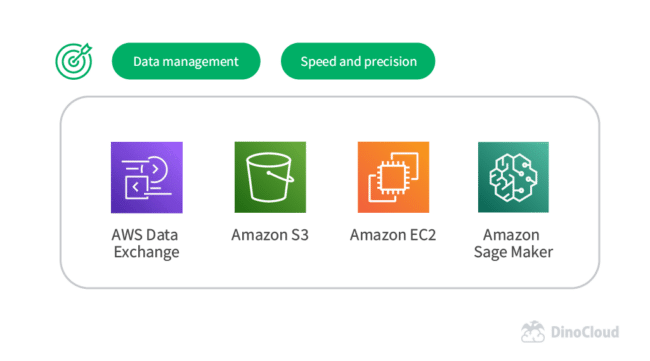
    1. Data management: Acquiring, storing, and analyzing data is essential for pharmaceutical research. Moderna needed a robust solution to handle large volumes of diverse and complex information, including genomic, clinical, and epidemiological data.
    2. Speed and precision: The urgency of the pandemic required Moderna to accelerate its vaccine development process without compromising quality and safety. They needed a technological infrastructure that would allow for rapid and precise analysis to meet demanding deadlines.

The AWS solution

To address these challenges, Moderna leveraged a series of advanced AWS services that provided the necessary tools to efficiently manage data and accelerate its research and development process:

    1. AWS Data Exchange: Moderna used AWS Data Exchange to access a wide variety of data relevant to its research. This platform allowed them to discover, acquire, and share data efficiently, facilitating the integration of critical information into their studies. Thanks to AWS Data Exchange, Moderna was able to quickly access genomic, clinical, and epidemiological data, speeding up analysis and decision-making.
    2. Amazon S3: Moderna stored its data in Amazon S3, a scalable and secure storage service. Amazon S3 allowed them to access data quickly and reliably, ensuring that all information was available when needed. The ability to scale storage as needed provided the flexibility required to handle the growing volume of data without compromising security.
    3. Amazon EC2: For data processing and simulations, Moderna used Amazon EC2 instances. These scalable instances allowed them to perform intensive calculations efficiently, optimizing the use of computational resources. Amazon EC2 provided the processing power necessary to analyze large datasets and conduct complex simulations, speeding up vaccine development.
    4. Amazon SageMaker: Moderna applied machine learning techniques using Amazon SageMaker. This service helped them analyze data, identify patterns, and accelerate research through the implementation of machine learning models. With Amazon SageMaker, Moderna was able to develop predictive models that improved the accuracy of their analyses and enabled a better understanding of the data.

Results and contribution

Thanks to AWS’s advanced infrastructure, Moderna achieved outstanding results in its fight against COVID-19:

      • Rapid vaccine development: Collaboration with AWS enabled Moderna to significantly accelerate the vaccine development process. The ability to access and analyze data efficiently was crucial to developing a vaccine in record time, marking a milestone in pharmaceutical research history.
      • Resource optimization: Moderna was able to use resources more efficiently, reducing costs and research time. The scalability and flexibility of AWS services allowed Moderna to adapt its technological needs according to the requirements of the moment, optimizing the use of its resources.
      • Global impact: By May 2021, Moderna had delivered over 100 million doses of its COVID-19 vaccine. Their innovative approach and use of advanced technologies had a significant impact on global health, helping to control the pandemic and save countless lives.
Moderna has shown that, with the right infrastructure and the ability to effectively leverage data and technology, it is possible to tackle global challenges with agility and precision. The collaboration between Moderna and AWS is a testament to the power of technological innovation and its potential to transform public health in times of crisis. In a world where speed and efficiency are crucial, the modernization of pharmaceutical research through solutions like AWS Data Exchange is not only a competitive advantage but a vital necessity for protecting global health.

Source Links

The COVID-19 pandemic highlighted the crucial importance of medical research and the rapid production of vaccines. In this context, Moderna, a pioneering company in the development of messenger RNA (mRNA) drugs, has played a fundamental role. Moderna not only led the race to develop an effective vaccine against COVID-19 but also set new standards in pharmaceutical research. Today, we will explore how Moderna used Amazon Web Services (AWS) to accelerate its vaccine research and development, facing unprecedented challenges and achieving extraordinary results.

In today’s fast-paced digital world, artificial intelligence (AI) and machine learning (ML) are crucial for businesses aiming to boost innovation and efficiency. Imagine the transformative power at your fingertips with Amazon Web Services (AWS)’s robust AI infrastructure. Join us as we explore the groundbreaking AI innovations reshaping cloud computing’s future.

Amazon has led in AI and ML for 25 years, enhancing daily tasks like shopping suggestions and packaging. AWS brings this know-how to our customers, equipping developers, data scientists, and experts with the tools to wield AI’s power. Now, AWS AI is a significant business, with over 100,000 customers from adidas to Toyota using our services to transform their customer interactions.

AWS AI’s true brilliance extends beyond this. The latest in natural language processing, computer vision, and more is powered by our platform. So, what makes AWS stand out in AI and ML innovation? Let’s explore this further.

The challenge

Moderna faced several critical challenges in its mission to develop a COVID-19 vaccine:

    1. Data management: Acquiring, storing, and analyzing data is essential for pharmaceutical research. Moderna needed a robust solution to handle large volumes of diverse and complex information, including genomic, clinical, and epidemiological data.
    2. Speed and precision: The urgency of the pandemic required Moderna to accelerate its vaccine development process without compromising quality and safety. They needed a technological infrastructure that would allow for rapid and precise analysis to meet demanding deadlines.

The AWS solution

To address these challenges, Moderna leveraged a series of advanced AWS services that provided the necessary tools to efficiently manage data and accelerate its research and development process:

    1. AWS Data Exchange: Moderna used AWS Data Exchange to access a wide variety of data relevant to its research. This platform allowed them to discover, acquire, and share data efficiently, facilitating the integration of critical information into their studies. Thanks to AWS Data Exchange, Moderna was able to quickly access genomic, clinical, and epidemiological data, speeding up analysis and decision-making.
    2. Amazon S3: Moderna stored its data in Amazon S3, a scalable and secure storage service. Amazon S3 allowed them to access data quickly and reliably, ensuring that all information was available when needed. The ability to scale storage as needed provided the flexibility required to handle the growing volume of data without compromising security.
    3. Amazon EC2: For data processing and simulations, Moderna used Amazon EC2 instances. These scalable instances allowed them to perform intensive calculations efficiently, optimizing the use of computational resources. Amazon EC2 provided the processing power necessary to analyze large datasets and conduct complex simulations, speeding up vaccine development.
    4. Amazon SageMaker: Moderna applied machine learning techniques using Amazon SageMaker. This service helped them analyze data, identify patterns, and accelerate research through the implementation of machine learning models. With Amazon SageMaker, Moderna was able to develop predictive models that improved the accuracy of their analyses and enabled a better understanding of the data.

Results and contribution

Thanks to AWS’s advanced infrastructure, Moderna achieved outstanding results in its fight against COVID-19:

      • Rapid vaccine development: Collaboration with AWS enabled Moderna to significantly accelerate the vaccine development process. The ability to access and analyze data efficiently was crucial to developing a vaccine in record time, marking a milestone in pharmaceutical research history.
      • Resource optimization: Moderna was able to use resources more efficiently, reducing costs and research time. The scalability and flexibility of AWS services allowed Moderna to adapt its technological needs according to the requirements of the moment, optimizing the use of its resources.
      • Global impact: By May 2021, Moderna had delivered over 100 million doses of its COVID-19 vaccine. Their innovative approach and use of advanced technologies had a significant impact on global health, helping to control the pandemic and save countless lives.
Moderna has shown that, with the right infrastructure and the ability to effectively leverage data and technology, it is possible to tackle global challenges with agility and precision. The collaboration between Moderna and AWS is a testament to the power of technological innovation and its potential to transform public health in times of crisis. In a world where speed and efficiency are crucial, the modernization of pharmaceutical research through solutions like AWS Data Exchange is not only a competitive advantage but a vital necessity for protecting global health.

Source Links

Reco AWS

In today’s fast-paced digital world, artificial intelligence (AI) and machine learning (ML) are crucial for businesses aiming to boost innovation and efficiency. Imagine the transformative power at your fingertips with Amazon Web Services (AWS)’s robust AI infrastructure. Join us as we explore the groundbreaking AI innovations reshaping cloud computing’s future.

Amazon has led in AI and ML for 25 years, enhancing daily tasks like shopping suggestions and packaging. AWS brings this know-how to our customers, equipping developers, data scientists, and experts with the tools to wield AI’s power. Now, AWS AI is a significant business, with over 100,000 customers from adidas to Toyota using our services to transform their customer interactions.

AWS AI’s true brilliance extends beyond this. The latest in natural language processing, computer vision, and more is powered by our platform. So, what makes AWS stand out in AI and ML innovation? Let’s explore this further.

Key Takeaways

  • AWS provides the most comprehensive, secure, and price-performant AI infrastructure for all your training and inference needs.
  • AWS offers the broadest and deepest set of AI and ML capabilities across compute, networking, and storage, empowering developers and data scientists to build cutting-edge solutions.
  • The AWS platform supports distributed training jobs using the latest purpose-built chips or GPUs, with managed services to streamline the process.
  • AWS AI and ML services are now used by over 100,000 customers across various industries, driving innovation and transforming customer experiences.
  • Many of the leading generative AI models are trained and run on the AWS platform, demonstrating its unparalleled capabilities in powering the future of cloud computing.

AWS: Comprehensive, Secure, and Price-Performant AI Infrastructure

At AWS, we deliver the most comprehensive, secure, and cost-effective AI infrastructure for your training and inference needs. Our platform boasts the broadest and deepest set of AI and machine learning (ML) capabilities across compute, networking, and storage. This enables you to effortlessly build advanced solutions.

Compute, Networking, and Storage for Training and Inference

Our infrastructure supports your entire AI workflow, from training large models to efficiently running inference. Utilize our managed services and purpose-built chips to accelerate your AI projects. Our global network and data centers ensure low latency and high performance for your applications.

GPU-enabled Distributed Training for Large-Scale Models

Our GPU-enabled infrastructure simplifies training large-scale models. We offer seamless distributed training capabilities, allowing you to scale your workloads across thousands of GPUs with low-latency networking. Our services and platforms are designed to enhance the performance and cost-efficiency of your AWS AI training and AWS AI inference workloads.

With over 15 years of experience in building large-scale data centers and more than 12 years in GPU-based server development, we have a vast existing footprint of AWS AI infrastructure to support your most ambitious AI projects. Trust AWS to power your cloud-native AI solutions and drive your business forward.

Networking Innovations for Low Latency and Large Scale

In the realm of generative AI, where large and intricate models dominate, the need to cut network latency and enhance performance is paramount for effective training and deployment. AWS has pioneered a distinct strategy to address these issues by constructing our network devices and software entirely from scratch.

Elastic Fabric Adapter: OS Bypass for High-Performance Networking

The Elastic Fabric Adapter (EFA) is our bespoke network interface card, featuring an OS bypass capability. This enables direct access to the network hardware, facilitating low-latency, high-throughput communication between instances. Such an approach is pivotal for optimizing the performance of distributed training workloads for extensive AWS ai networking endeavors.

UltraCluster 2.0: Supporting 20,000+ GPUs with Sub-10μs Latency

To meet the escalating needs for AWS large scale networking, we’ve unveiled UltraCluster 2.0, our cutting-edge networking solution. This version can now accommodate over 20,000 GPUs with sub-10 microsecond latency, a 25% enhancement over the preceding generation. The swift development of UltraCluster 2.0, achieved in merely seven months, underscores our sustained commitment to custom network devices and software. This commitment enables us to AWS ultracluster and innovate at an unmatched velocity.

Through our AWS efa and UltraCluster 2.0 breakthroughs, we empower our clientele to expedite the training of their most extensive and intricate AWS low latency networking models. This, in turn, accelerates the tempo of AI-driven innovation.

Continuous Data Center Efficiency Improvements

At AWS, our dedication to efficient operations is unwavering. We aim to minimize our environmental footprint while offering our customers significant cost savings. Our efforts have been focused on enhancing energy efficiency across our global infrastructure. We’ve explored innovative cooling systems and optimized airflow performance.

Optimizing Cooling Systems and Airflow Performance

Improving the longevity and airflow performance of our data center cooling systems has been a priority. We employ advanced modeling to predict a data center’s performance before construction. This allows us to strategically place servers in racks and throughout the data hall, enhancing power utilization.

Our latest designs integrate optimized air-cooling solutions with liquid cooling for the most advanced AI chipsets, such as the NVIDIA Grace Blackwell Superchips. This multimodal cooling strategy ensures peak performance and efficiency across various workloads, from traditional to AI and machine learning.

Multimodal Cooling Design for AI Chipsets

The surge in demand for high-performance AI and machine learning has driven our investment in innovative cooling solutions. Our multimodal cooling design dynamically adjusts cooling methods to meet workload requirements, ensuring peak performance and efficiency.

Metric Improvement
Data Center Energy Efficiency 40% reduction in cooling costs with AI-powered optimization
Emissions Reduction 24 million pounds of CO2 reduced annually with renewable energy
Water Consumption Significant savings through advanced clean-in-place solutions

Our ongoing commitment to improving data center efficiency not only reduces our environmental impact but also benefits our customers by lowering costs. Innovation in this area is central to our mission of creating a sustainable future for cloud computing.

AWS AI Innovations: Security from the Ground Up

At AWS, we prioritize security to empower customers using artificial intelligence (AI) and machine learning (ML). As AI and ML evolve, protecting sensitive data and ensuring trust in these technologies is crucial. Our security approach focuses on three key principles: isolating AI data from the infrastructure operator, allowing customers to isolate their data, and securing infrastructure communications.

Nitro System for Isolating Customer Data and Code

In 2017, we introduced the AWS Nitro System, a groundbreaking innovation. It protects customers’ code and data from unauthorized access during processing. The Nitro System ensures a secure environment, preventing the infrastructure operator from accessing customer content and AI data like model weights and processed data.

Nitro Enclaves and AWS KMS for Secure AI Data Encryption

We’ve integrated AWS Nitro Enclaves and AWS Key Management Service (AWS KMS) to allow customers to isolate their AI data. Nitro Enclaves provide a trusted environment for keeping AI data isolated and encrypted, even from the customers and their software. AWS KMS enables customers to manage their encryption keys, enhancing the security of their AI data.

These innovative security measures empower our customers to leverage AI and ML confidently. They know their data and intellectual property are secure from the start. As we advance in cloud computing, trust that AWS remains committed to being the most secure and reliable global cloud infrastructure. We support the responsible development and deployment of AI technologies.

AWS AI Chips: Purpose-Built for Superior Performance

At AWS, we recognize the critical role of the chips driving generative AI. These chips directly affect the efficiency, cost-effectiveness, and sustainability of training and running these models. For years, we’ve focused on innovating and designing our own specialized AI chips. Our goal is to help our customers manage costs effectively and make AI more accessible across various industries.

AWS Trainium: Accelerating Model Training by Up to 50%

The AWS Trainium chip is engineered to significantly accelerate and reduce the cost of training machine learning models. It can speed up training by up to 50% compared to similar Amazon EC2 instances. This is made possible through its specialized architecture, featuring two second-generation NeuronCores designed for deep learning algorithms.

Introduced in 2022, the latest Trn1 instances boast an impressive bandwidth of 800 Gbps. The Trn1n instances, launched later, have doubled this to 1600 Gbps, enhancing training performance by 20%. These advancements make Trainium a robust choice for companies like Johnson & Johnson. They can achieve cost efficiency, performance, and energy efficiency in their healthcare applications.

AWS Inferentia: Enabling Efficient Model Inference

The AWS Inferentia complements the Trainium chip by facilitating efficient model inference. The latest Inferentia2 chip offers up to four times higher throughput and up to 10 times lower latency than the first-generation Inf1 chips. This results in up to 40% better price performance when deploying generative AI models on Inf2 instances. These instances also show a 50% improvement in performance per watt over other Amazon EC2 instances.

Companies like Finch AI, Sprinklr, Money Forward, and Amazon Alexa have adopted Inferentia-powered instances for deep learning and generative AI inference. They benefit from the chip’s capability to run models more swiftly and at a lower cost. The Inferentia2 chip’s architecture, with two second-generation NeuronCores and up to 190 TFLOPS of FP16 performance, further boosts its efficiency and versatility for diverse AI tasks.

Whether it’s Trainium for accelerated model training or Inferentia for efficient inference, our purpose-built AWS AI chips are crafted to unlock the full potential of generative AI. They ensure cost-effectiveness and energy efficiency. By utilizing these specialized chips, companies can enhance model quality for the same expenditure and achieve more with less. This paves the way for the future of cloud computing.

AWS AI Innovations: Powering the Future of Cloud

At AWS, we see the future of cloud computing as deeply intertwined with the transformative potential of AI and machine learning (ML). For over two and a half decades, Amazon has been at the forefront of AI and ML, enhancing daily tasks such as shopping suggestions and packaging. Now, we’re extending this expertise to our customers, making ML accessible to every developer, data scientist, and expert practitioner.

Our AWS AI and ML services have grown into a multibillion-dollar business, serving over 100,000 customers across various sectors. Companies like adidas, the New York Stock Exchange, Pfizer, Ryanair, and Toyota leverage our secure and efficient AI infrastructure to transform customer experiences. Additionally, many leading generative AI models are trained and deployed on the AWS cloud ai platform.

We’re excited to share that AWS ai innovations could boost global GDP by 7 percent over a decade, totaling almost $7 trillion. Our advanced technologies, including Amazon Bedrock and Amazon SageMaker, empower organizations to achieve unprecedented productivity and efficiency.

  • Amazon Bedrock provides a broad spectrum of foundation models, including open-source and proprietary ones, to aid in developing unique applications.
  • Amazon SageMaker streamlines the deployment and personalization of these models, enabling users to finish data preparation tasks in mere minutes.

As the AWS ai future emerges, we pledge to support both public and private sectors. Our Generative AI Innovation Center delves into deep science applications and fosters strong customer relationships. Moreover, our responsible AI practices are woven throughout the AI lifecycle.

At AWS, we’re convinced that the true potential of AI and ML is yet to be fully tapped. With sustained investments and a relentless focus on innovation, we’re eager to help our customers redefine the cloud’s possibilities.

Conclusion

AWS stands at the forefront of cloud computing’s future, offering unparalleled AI infrastructure. We’re constantly innovating, enhancing our AI capabilities in areas like networking and data center efficiency. Our aim is to empower developers and enterprises alike, enabling them to fully harness AI and machine learning for business transformation and innovation.

Our suite of AI and ML tools, managed services, and custom hardware positions us to support our customers in the generative AI era and beyond. We’ve made advanced AI solutions accessible to all, offering up to 28% faster coding and accelerating data work with tools like QuickSight Q.

Our AI innovations are transforming sectors such as sports, travel booking, pharmaceuticals, media, and CRM. We’re dedicated to improving security, offering flexibility, and enhancing performance to meet our customers’ evolving demands. As we explore the frontiers of AI, AWS is the trusted ally for organizations seeking to create new opportunities and make a lasting impact.

FAQ

What is AWS’s focus on AI and machine learning?

Amazon has been at the forefront of AI and machine learning (ML) for over 25 years. This expertise powers daily tasks like recommending products and deciding on packaging. Through Amazon Web Services (AWS), we empower developers, data scientists, and experts with ML. Today, AI is a significant part of AWS, generating billions in revenue annually.

How many customers are using AWS AI and ML services?

Over 100,000 customers from various sectors, including adidas, New York Stock Exchange, Pfizer, Ryanair, and Toyota, leverage AWS’s AI and ML. They use these services to transform customer experiences.

What are the key features of AWS’s AI infrastructure?

AWS offers a comprehensive, secure, and cost-effective AI infrastructure for training and inference. It boasts the widest range of AI and ML capabilities across compute, networking, and storage. Customers can execute distributed training jobs using cutting-edge chips or GPUs with managed services.

How does AWS address network latency and performance for generative AI models?

AWS has developed its own network devices and operating systems for every infrastructure layer. This approach enhances security, reliability, and performance while allowing for rapid innovation. Our UltraCluster 2.0 network supports over 20,000 GPUs, reducing latency by 25%.

How does AWS address energy efficiency for training and running AI models?

AWS aims to run efficiently to minimize environmental impact. We’ve improved energy efficiency by optimizing cooling systems, using advanced modeling, and constructing data centers with eco-friendly materials. Our latest design combines air and liquid cooling for the most advanced AI chipsets.

Source Links

Data Cloud

We, at DinoCloud, embrace this spirit. Being a top-tier partner with AWS, we provide cutting-edge, tailor-made solutions. These solutions enhance operational performance and ensure data safety for our clients. The emergence of serverless computing has marked a significant shift in the development and deployment of modern applications.

This guide explores the widespread applications of serverless computing. It details the pros and cons and outlines a user-friendly path to adopting serverless technologies. In the ever-evolving cloud computing world, we’ll examine serverless architecture, function as a service (FaaS), and the array of cloud functions available via AWS Lambda. We’ll also dive into the features of event-driven architecture, microservices, scalability, and how the pay-per-use concept revolutionizes serverless computing.

Key Takeaways

  • Serverless computing offers cost savings through a pay-per-use model, eliminating the need for server maintenance.
  • Serverless architectures automatically scale to handle fluctuations in traffic, providing seamless scalability.
  • Developers can focus on building specific functions without worrying about the underlying infrastructure, simplifying backend coding.
  • Serverless computing accelerates the development cycle, enabling quicker feature deployment.
  • Potential drawbacks include cold starts, runtime limitations, vendor lock-in, and complex debugging.

What is Serverless Computing?

Serverless computing is a modern approach to backend services. It relies on a pay-as-you-go model. This approach lets users create and run code without handling the infrastructure.

Developers can easily access backend services. They pay only for what they use. This means they avoid paying for idle servers.

Event-Driven Execution

Serverless architectures work on an event-driven basis. Resources are only used when an event triggers code. This method efficiently manages computing resources.

Automatic Scaling

Serverless computing automatically adjusts resources to meet demand. The provider takes care of scaling up or down, handling traffic changes. This removes the need for manual efforts to adjust resources.

Granular Billing

One of the benefits of serverless computing is its detailed billing model. Users pay only for what they use. This can result in substantial cost reductions for organizations.

Short-Lived and Stateless Functions

Serverless functions are designed to be quick and without a lasting state. They promote modularity and easy scaling. Developers can update or deploy these functions independently.

Third-Party Service Integration

It integrates smoothly with many third-party services. Developers are free to focus on their core applications. They don’t need to worry about the infrastructure of these additional services.

Reduced Administrative Overhead

Serverless computing reduces the server management load. Developers can concentrate on improving their applications. This shifts the focus to providing better business value.

Backend Services in Serverless Computing

Serverless computing offers a wide array of backend services. These include databases, storage, and Function-as-a-Service (FaaS) like Cloudflare Workers. With FaaS, developers can execute small sections of code at the edge of the network. This approach leads to a more modular design and makes scaling code easier, freeing developers from maintaining the backend.

Function-as-a-Service (FaaS)

FaaS is integral in serverless setups, enabling the execution of small, independent functions. It does this in response to particular events or triggers. This method obviates the need to oversee server infrastructure, streamlining backend development. Developers can concentrate on coding these functions. This is opposed to the management of entire applications. AWS Lambda are example of FaaS. They provide an economical and flexible solution for running backend operations.

Databases and Storage

In serverless computing, database and storage services are available. They do away with the manual setup and expansion of database hardware. Serverless databases, like Amazon DynamoDB,, follow a pay-as-you-go approach. This allows for simple scaling of storage and compute resources. Serverless storage options, such as AWS S3, also offer benefits. These include scalability, reliability, and a pocket-friendly way to manage data. Such services ensure developers can concentrate on app development. They do so without the hassle of maintaining database or storage infrastructures.

Serverless vs Other Cloud Models

Serverless computing is akin to Backend-as-a-Service (BaaS), Platform-as-a-Service (PaaS), and Infrastructure-as-a-Service (IaaS). However, each variety boasts unique offerings that distinguish it from the rest.

Backend-as-a-Service (BaaS)

BaaS simplifies backend tasks like data storage, freeing up developers to concentrate on front-end endeavors. Yet, its functionality might lack in the event-driven and edge-computing aspects, which are robust in serverless compute environments.

Platform-as-a-Service (PaaS)

PaaS serves as an extensive platform for both app development and deployment. Despite its broad utility, scaling can sometimes be less smooth, and it tends to face startup delays in comparison to the agility of serverless setups.

Infrastructure-as-a-Service (IaaS)

In the IaaS realm, cloud providers handle the bulk of infrastructure management for their clients. This paradigm sometimes includes serverless features, potentially causing confusion by weaving aspects of both models together.

Cloud Model Key Characteristics Advantages Disadvantages
Serverless Computing
  • Event-driven execution
  • Automatic scaling
  • Granular billing
  • Short-lived and stateless functions
  • Third-party service integration
  • Reduced administrative overhead
  • Cost savings (pay-per-use)
  • Effortless scalability
  • Simplified backend coding
  • Faster development cycles
  • Cold starts leading to latency
  • Runtime limitations
  • Vendor lock-in risks
  • Complex debugging
Backend-as-a-Service (BaaS)
  • Provides backend functions like data storage
  • Allows developers to focus on frontend
  • May not fulfill event-driven and edge-computing requirements
  • Reduced backend development effort
  • Simplified app architecture
  • Limited control over backend
  • Potential vendor lock-in
  • Dependence on third-party services
Platform-as-a-Service (PaaS)
  • Comprehensive app development and deployment environment
  • May not scale as seamlessly as serverless
  • Potential startup delays compared to serverless
  • Reduced infrastructure management
  • Streamlined app development
  • Limited flexibility in customization
  • Vendor lock-in concerns
  • Performance issues due to shared resources
Infrastructure-as-a-Service (IaaS)
  • Cloud vendors manage infrastructure for customers
  • Some IaaS providers offer serverless features
  • Scalable infrastructure on-demand
  • Reduced capital expenditure
  • Requires more infrastructure management
  • Potential vendor lock-in
  • Security and compliance challenges

Advantages of Serverless Computing

Serverless Computing is a game-changer in app development, with cost savings and effortless scalability among its top benefits. With this model, you only pay for what you use, which helps cut expenses. The provider manages scaling automatically, freeing up developers to focus on code. This approach simplifies the backend, boosting development speed and making feature deployment faster.

The pay-as-you-go setup in serverless computing greatly impacts organizations. They get to cut fixed costs, which is a win for their cash flow. Plus, it can often be more budget-friendly than traditional cloud hosting, as costs are tied directly to active server use. This leads to significant savings over time.

Next, the ease of scalability in serverless computing is a major win. The system automatically feeds more resources when needed, such as during spikes in user activity. This dynamic scaling means developers can concentrate on app creation. They don’t need to spend time managing or planning for future server requirements.

Serverless computing also simplifies coding, particularly for the backend. Working with modular functions, developers can set up and run code without dealing with infrastructure. This modular framework makes the code easier to scale and maintain, which streamlines the development process.

Last but not least, the speed at which new features can be added is a clear advantage. Quick deployment means products hit the market sooner, giving companies an edge. This rapid response to market needs is crucial for staying competitive and satisfying customer demands.

Disadvantages of Serverless Computing

Serverless computing brings significant benefits, yet it has drawbacks. It can encounter cold starts that lead to latency issues. Also, runtime limitations pose challenges for certain programming languages and executing time-consuming tasks. Moreover, vendor lock-in and complex debugging are problems due to serverless applications’ distributed nature.

Cold Starts

Serverless computing’s “cold starts” bring widely varying processing times. Code deployment on different server specs causes this. For time-sensitive applications, these latency spikes can be a major issue.

Limited Runtime

Serverless platforms have runtime restrictions. This makes using some programming languages or completing long tasks a challenge. Applications needing intensive processing or consistent states face significant obstacles.

Vendor Lock-In

Moving between serverless providers is hard due to unique configurations. This vendor lock-in makes platform switching complex. It limits organizational flexibility and increases reliance on a single provider.

Complex Debugging

Testing and debugging serverless applications is complex. Replicating production environments is hard, and backend process visibility is often limited. This complexity increases development and maintenance costs.

Benefits of Serverless Computing

In modern application development, Serverless Computing stands out. It brings cost savings by charging only for what you use. Effortless scalability is handled by the provider. With simplified backend coding and modular functions, developers enjoy faster development cycles and quicker feature deployment.

Cost Savings

Organizations can save money with serverless computing. They pay only for the resources they use instead of pre-buying capacity. This cost-effective approach is great for workloads that change. It cuts out over-provisioning, which increases efficiency and cuts costs.

Effortless Scalability

Serverless computing offers automatic scaling. Applications can easily handle changes in traffic and demand. Developers are free to innovate without the worry of scaling infrastructure. Plus, pay-per-use billing means you can scale as needed.

Simplified Backend Coding

In a serverless setup, developers can mainly focus on the front-end development. The backend is taken care of by the serverless provider. This approach makes the coding process simple. It helps teams deploy new features quickly. Built-in service integrations also make development smoother.

Speedier Development

The nature of serverless computing allows teams to work more quickly. They can try out new ideas, update features, and meet customer needs fast. All this happens without the usual infrastructure management. As a result, products get to market faster, and companies can adapt to changes swiftly.

Serverless Computing Benefits Description
Cost Savings Pay-per-use model and automatic scaling eliminate over-provisioning, leading to significant cost savings.
Effortless Scalability Serverless platforms handle scaling automatically, allowing developers to focus on building features.
Simplified Backend Coding Serverless computing enables developers to concentrate on front-end development, with backend functions managed by the provider.
Speedier Development The scalability and reduced administrative overhead of serverless computing accelerate the development and deployment of new features.

Use Cases for Serverless Architecture

Serverless architecture stands out by serving diverse needs efficiently. It’s found in web and mobile application development, real-time data stream processing, and more. This method changes how companies view their tech setup.

Web and Mobile Backends

Building serverless APIs is straightforward and cost-efficient. They adapt well to usage spikes, perfect for web and mobile app backends. This approach skips the initial burdens of setting up complex infrastructures.

Stream Processing

Triggered by messages or logs, serverless processing handles real-time tasks without managing clusters. It’s a top choice for image recognition and rich media apps, saving time and money. The method behind this is straightforward yet powerful.

ETL Pipelines

Serverless architecture suits scalable data processing pipelines perfectly. These pipelines handle data extraction, transformation, and loading hassle-free. The result is agile and efficient data processing without the usual upkeep load.

Event Processing

For event-based actions like security checks, serverless functions are unmatched. They optimize workflows like automated testing and website deployments. This speeds up development and operation activities, benefitting delivery speed and scalability.

Cron Jobs

Scheduling tasks via serverless methods means no worries about dedicated servers. It fits well for tasks not on schedule, adjusting server use automatically. Demand-based scaling avoids over-provisioning and keeps resources efficient.

Microservices

In the realm of microservices, serverless concepts thrive. They allow for independent, easily scalable, and maintainable small services. This model boosts flexibility, quickens deployment, and enhances system robustness.

Serverless adoption grows as its flexibility shines in various scenarios. Organizations worldwide benefit from its adaptable nature. Our experts at DinoCloud excel in navigating this serverless path, empowering businesses with cloud-native solutions. This guidance is pivotal for those aiming to maximize the benefits of serverless and fuel their digital progress.

Conclusion

Serverless computing faces certain hurdles, but its pros outweigh the cons. It saves money, scales easily, simplifies coding in the backend, and speeds up development. However, it’s crucial to see if it’s right for a particular use. DinoCloud leads the way in advising businesses on their serverless path. They ensure a smooth start and offer strategic advice.

Our expert team is eager to aid companies in making the most of serverless computing. By embracing serverless adoption, businesses improve their use of resources. They cut down on costs and can put more focus on being innovative and enhancing customer experiences.

The serverless computing community is vibrant and filled with useful services. This aids in creating applications packed with features. DinoCloud knows the cloud and all about serverless technologies. This makes us a reliable partner for those wanting to smoothly transition to this powerful computing model.

FAQ

What is Serverless Computing?

Serverless computing transcends traditional backend models by operating on-demand. It frees users from managing infrastructure. Developers seamlessly access backend services, only paying for what they use.

What are the key characteristics of Serverless Computing?

Serverless computing boasts distinctive event-driven execution and automatic scaling. It offers granular billing for efficiencies. Its functions are agile and ephemeral, designed to integrate third-party services easily.

What Backend Services are available in Serverless Computing?

Its services span databases and storage, plus Function-as-a-Service capabilities. For instance, Cloudflare Workers facilitate deployment at the network edge. This promotes modularity and scalability in applications.

How does Serverless Computing differ from other Cloud Computing models?

While similar to BaaS, PaaS, and IaaS, serverless computing’s unique selling point lies in its event-driven and usage-based model. BaaS supports storage, PaaS eases app development, and IaaS involves managing customer infrastructure, sometimes with serverless options.

What are the advantages of Serverless Computing?

Serverless Computing brings notable benefits. These include cost savings from pay-as-you-go pricing, automatic scaling for growth, and modular architecture for simplified development. It significantly accelerates feature deployment.

Source Links

Amazon Q

Amazon Q Developer embodies the profound words of Dove. It stands as an AI-assistant, aiding developers and engineers. It enhances their work within the AWS platform via advanced operational and development solutions.

Amazon Q Developer acts as a generative AI-powered conversational assistant. Its prime function is aiding in the operation and development of AWS applications. It sports natural language processing capabilities. This means you can inquire about a wide array of topics. These include AWS architecture, resources, and even best practices. Amazon Q is diligently updated. This keeps its knowledge and advice always fresh and pertinent to your queries.

No matter where you are in your AWS journey, Amazon Q Developer offers invaluable guidance. It’s specifically designed to usher you through the intricate AWS ecosystem. The goal is simple: to boost your development processes. With features like code completion, security checks, and architecture advice, your handling of AWS will be completely transformed.

Key Takeaways

– Amazon Q Developer is a generative AI assistant that provides conversational support for AWS applications.
– It offers a wide range of features, including code chat, completion, security vulnerability scanning, and upgrade recommendations.
– Amazon Q is powered by Amazon Bedrock, a service that provides foundation models through an API.
– Users can access Amazon Q through various channels, including AWS apps, websites, IDEs, command line, and chat platforms like Slack.
– Amazon Q Developer is available through both a Free Tier and a Pro subscription model, catering to different user needs.

Introduction to Amazon Q Developer

Driven by Amazon Bedrock, AWS deploys automated abuse detection via Amazon Q Developer. This setup empowers users to utilize controls from Amazon Bedrock. It ensures the safe and responsible application of artificial intelligence (AI).

Overview of Amazon Q Developer

Amazon Q Developer stands as a dynamic AI-enhanced assistant. It elevates your capacity to construct, manage, and refine applications on the AWS cloud. This tool offers a spectrum of services, from aiding in conversations to providing complex software development advice.

It enables rapid cloud integration and refines your development procedures.

Key Features of Amazon Q Developer

Equipped with capabilities like code completion chat, Amazon Q Developer boosts productivity through generative AI. It also includes a Comprehensive Guide to Amazon Q Developer for Your IDE. This guide elevates users’ efficiency in utilizing Amazon Q Developer.

Coding with Q Developer supports both the creation of new applications and adaptations to existing ones.

Moreover, Amazon Q Developer features a weekly show, Build On. Here, the hosts showcase how the tool resolves coding challenges. It helps with tasks like adding a new serverless API in Python. It also guides in producing and deploying Python-based reporting scripts.

Engaging in frontend development using Q Developer demonstrates its capacity to efficiently produce Vue components. The process includes convenient drag and drop options.

Q Developer is also adept at demystifying intricate error messages. Furthermore, it aids in codebase modernization, migrations or updates, and the containerization of applications. Its Q Code Transformation service supports Java applications from versions 8 and 11 to 17. It assist with various architecture modifications as well, like moving databases to OpenSearch.

Additionally, Amazon Q contributes to resolving data consistency problems in distributed systems.

Getting Started with Amazon Q Developer

Learning to use Amazon Q Developer is straightforward. It provides various entry points for ease of access. This AI tool enriches both AWS applications and websites by allowing intuitive interactions through natural language.

Moreover, Amazon Q Developer easily integrates into IDEs, enhancing your software creation process. It’s designed to make your development more efficient.

Accessing Amazon Q Developer on AWS Apps and Websites

To start with Amazon Q Developer on AWS platforms, you first ensure the right permissions are in place. This gives your applications the power to communicate naturally with your users. Information gathering, guidance, and issue resolution all become part of the user’s experience.

This integration not only improves customer support but also enhances user engagement.

Installing Amazon Q Developer in IDEs

For developers, incorporating Amazon Q Developer into IDEs such as Visual Studio Code and JetBrains IDEs is a breeze. By adding the Amazon Q Developer extension, a variety of features become available in your coding environment. These features include real-time code completion, contextual advice, and handling errors.

Ultimately, utilizing Amazon Q Developer substantially improves the software development process.

Using Amazon Q Developer on the Command Line

Direct access to Amazon Q Developer is also possible via the command line. Installing the Amazon Q Developer agent on macOS allows its usage from the terminal. This facilitates quick information acquisition, issue solving, and interaction with AWS resources through natural language commands.

Such a method benefits developers and IT professionals by fitting Amazon Q Developer into their existing command-line routines.

Chatting with Amazon Q Developer in AWS Chatbot

Those who prefer chat-based interaction can connect with Amazon Q Developer through AWS Chatbot. Support for popular collaboration services like Slack is included. Simply granting the AmazonQFullAccess policy to your IAM account allows for rich interactions with Amazon Q Developer in these apps.

Amazon Q Developer: Powering AWS Applications

The Amazon Q Developer, an AI-powered conversational assistant, dramatically enhances how you handle AWS apps and infrastructure. Its natural language processing lets you interact with and harness the full might of AWS effortlessly.

Conversational Assistance for AWS Architecture

Are you working on a new cloud-native app or improving an old one? The Amazon Q Developer offers insights and tips on AWS architecture best practices. It answers questions about service integrations, serverless design patterns, and scalability clearly and helpfully.

Understanding and Managing AWS Resources

The vast number of AWS services can be overwhelming. But, with the Amazon Q Developer, things get simplified. It’s your quick reference guide to finding specific service information, learning capabilities, and configuring resources effectively. This way, you can make smart choices and optimize your AWS setups.

Troubleshooting and Support with Amazon Q Developer

Encountered a problem with your AWS application or its infrastructure? The Amazon Q Developer is here to help with troubleshooting and support. It can assist with error messages, identify performance bottlenecks, and address security issues. By offering guidance on diagnosing and fixing issues, it helps you keep your AWS solutions running smoothly.

Amazon Q Developer for Software Development

Amazon Q Developer is a robust tool to aid software developers in various tasks. It incorporates advanced AI to provide code enhancements and real-time advice. It also stands as your assistant in code completion and transformation, making your development processes smoother and more efficient.

Code Improvements and Advice

Amazon Q Developer leverages state-of-the-art natural language processing and AI for in-depth code discussions. It guides you in adhering to best practices and offers tips to make your code more readable, efficient, and secure. It provides insightful feedback, pointing out areas for refactoring, optimizations, and how to fix common problems.

Real-Time Code Completion

In writing better and more precise code, Amazon Q Developer shines with its real-time completion feature. While you input your code, it examines the context and offers on-point suggestions. This feature easily integrates with various IDEs, ensuring your coding is both fast and accurate.

Agent for Code Transformation

Aside from enhancing code and suggesting completions, Amazon Q Developer also helps transform code. You can just communicate the changes or new features you wish to see, and it will formulate a plan and update the code accordingly. This function reduces the effort needed for low-level coding, leaving you more time to focus on overarching goals.

Amazon Q Developer: Optimizing Code and Security

Amazon Q Developer, as an AI-powered assistant, excels in refining code and boosting its security. It assists with various tasks, such as creating unit tests and identifying vulnerabilities. By delving into these features, we’ll see how it can improve your development process significantly.

Writing Unit Tests and Optimizing Code

The Amazon Q Developer Agent shines on the SWE-bench leaderboard, with impressive scores. Achieving 13.82% on the main benchmark and 20.33% on the lite version as of May 2024, it stands out among its peers. It shows its prowess by producing high-caliber code tested across different Python repositories.

Thanks to its use of natural language processing and AI, the agent supports developers in crafting top-notch unit tests and refining code. Its quick response time is a key feature, offering immediate results. This saves developers significant time, enhancing their efficiency.

Scanning for Vulnerabilities and Remediation

Amazon Q Developer extends its utility beyond code enhancement to support security scanning and remediation. Its understanding of code lets it pinpoint vulnerabilities, suggest fixes, and even make the necessary adjustments. This is crucial in fortifying your applications against potential threats.

Moreover, its capability to troubleshoot in the AWS Management Console further solidifies the security of your system. This allows you to maintain a secure and robust environment for your applications.

Benchmarking Amazon Q Developer’s Security Scanning

Though benchmarks like SWE-bench are insightful, they come with their own set of constraints. They often simplify results into binary outcomes, overlooking the nuanced benefits a solution like Amazon Q Developer can offer. These benefits include enhanced security and time-saving features.

To truly gauge the agent’s potential, evaluating its performance on private code repositories is advised. This method uncovers its real-world capabilities, shedding light on its security scanning proficiency. It also helps detect any signs of memorization, providing a more precise evaluation of its performance.

Conclusion

Amazon Q Developer stands as an advanced AI assistant, empowering users to enhance the development and operation of cloud applications on AWS. It combines conversational AWS support with rich software development features, propelling cloud adoption and workflow efficiency.

With impressive performance on benchmarks such as SWE-bench, Amazon Q Developer excels in code generation, debugging, and optimization. Its expertise covers AWS service selection, programming language syntax, and unit testing. This expertise enhances development processes, ensuring application quality and reliability.

Moreover, Amazon Q Developer enhances productivity by offering service-specific guidance, improvement suggestions, and error fixes. It does this right within our development settings and the AWS Management Console. This direct assistance boosts problem-solving capabilities and increases overall productivity. It aims to deliver enhanced efficiency, better code quality, and quicker development of cloud-native applications.

For businesses aiming to harness the full potential of Amazon Q Developer and enhance their AWS application development, DinoCloud is here to support you. Our team of AWS and AI experts can guide you through the entire process, ensuring you maximize the value of your development efforts. Discover more about how DinoCloud can transform your development journey here!

FAQ

What is Amazon Q Developer and how can I get started with it?

Amazon Q Developer is an AI-powered conversational assistant that leverages generative technology. It helps users in understanding, building, extending, and managing AWS applications. Users can inquire about AWS architecture, resources, best practices, support, and documentation. Getting started involves accessing Amazon Q Developer through AWS console, IDEs, command lines, and AWS Chatbot.

What are the key features of Amazon Q Developer?

Powered by Amazon Bedrock, Amazon Q Developer offers extensive capabilities for AWS applications and infrastructure. It provides conversational support, helps in software development, optimizes code, and scans for security issues. The AI assistant continuously improves, offering users the latest and most accurate answers.

How can Amazon Q Developer help with AWS applications and infrastructure?

Amazon Q Developer aids in various tasks related to AWS applications and their upkeep. It helps in managing resources, understanding architectural concepts, and troubleshooting. The AI responds contextually and provides actionable information, enabling users to build and maintain applications effectively on the AWS cloud.

What software development capabilities does Amazon Q Developer offer?

When it comes to software development, Amazon Q Developer is robust. It offers code improvements, real-time completion, and advice on transformation. These features enhance development workflows, enabling developers to produce secure, efficient code.

How can Amazon Q Developer help with code optimization and security?

Amazon Q Developer provides vital tools for optimizing code and enhancing its safety. It helps in writing unit tests, pinpointing vulnerabilities, and offering guidance for remediation. Additionally, the AI can benchmark your code’s security to maximize application safety.

Source Links