

Categories
Cloud Economics

AWS Machine Learning: Unlock AI Potential with AWS

AI aws

At DinoCloud, we excel in deploying bespoke solutions supported by AWS Machine Learning. Thanks to AWS, businesses unlock AI’s extensive potential, altering their strategies profoundly. Be it enhancing operational efficiency, refining data security, or fostering innovation, AWS equips companies with avant-garde ML solutions.

Key Takeaways:

  • Majority of industrial facilities struggle with processing vast volumes of unstructured data sourced from sensors, telemetry systems, and equipment dispersed across production lines.
  • Standalone foundation models (FMs) face context size constraints, typically handling less than 200,000 tokens, which can be problematic for processing complex industrial data.
  • Multi-shot prompting technique betters code generation accuracy, thus enhancing the consistency in creating Python code responses for NLQs.
  • Generative FMs are instrumental for asset health assessment, anomaly root cause analysis, and image-based part summaries for equipment diagnosis in industrial applications.
  • AWS offers a comprehensive solution architecture for NLQ with time series data, covering ML-driven systems, data translation, NLQ outputs, and Python code creation.

Through AWS Machine Learning, enterprises gain access to advanced AI tools and capabilities. Whether it’s monitoring the health of industrial equipment or creating intelligent text summaries, AWS customizes its offerings to meet diverse needs. By leveraging AI, organizations can lead the way in a world propelled by data.

Exploring AWS Machine Learning Algorithms and Models

AWS is a powerhouse in providing resources for machine learning. It gives businesses a broad selection of algorithms and models to innovate and achieve their objectives. These services from AWS make it quicker to create and use AI solutions, enhancing a company’s AI potential.

Amazon Machine Learning Services and Their Industrial Applications

Amazon SageMaker is a top-notch service within AWS. It offers a playground for constructing, educating, and delivering ML models. SageMaker lets you use advanced algorithms, enhance your data, and easily put your models to work. It is widely used in fields like manufacturing, healthcare, finance, and retail.

Integrating AWS ML Algorithms for Enhanced Operational Efficiency

By picking AWS ML algorithms, companies can introduce new efficiencies. These algorithms power data-led choices and automation, which elevate output and lower expenses. Using AWS ML models gives you tools for predictive insights, spotting anomalies, and more, to refine your processes.

Data Security and Management with AWS ML Solutions

Data safety is paramount when using machine learning. AWS offers strong security features to protect your data. It includes encryption and access controls. Also, AWS helps with managing data, from intake to analysis, simplifying the handling of vast datasets.

AWS Machine Learning: Power and Potential

AWS ML opens the door to AI’s potential for businesses. It helps them increase efficiency, innovate, and choose based on data. With Amazon SageMaker and more, they can speed up their ML projects. AWS ML lets businesses fully use AI and grow in the digital age.

Amazon ML Service Key Features
Amazon SageMaker – Pre-built algorithms and tools for accelerated ML development
– Data preprocessing and feature engineering capabilities
– Easy deployment of ML models to production environments
Amazon Polly – Text-to-speech conversion with lifelike synthesis
– Support for multiple languages and accents
– Control over pitch, speed, and other aspects of speech
Amazon Rekognition – Highly accurate facial recognition and analysis
– Scalable image and video analysis solutions
– Easy integration with other AWS services
Amazon Lex – Building voice and text chatbots
– Handling both text and speech requests
– Deep learning-based conversational capabilities
Amazon Comprehend – Natural language processing capabilities at scale
– Text analysis and topic modeling
– Insight generation and content automation
Amazon Transcribe – Speech-to-text conversion
– Real-time transcription services
– Handling low-quality audio and diverse accents
Amazon Translate – Fast and affordable language translation services
– Leveraging neural machine translation technology
– Support for a broad range of languages

The Role of AWS SageMaker in Streamlining ML Project Lifecycles

The process of machine learning is a multi-step journey. It starts with preparing data, moves on to training and tuning, and ends with deployment and monitoring. Each of these stages is vital for the successful creation and implementation of machine learning models. AWS SageMaker serves as a robust platform to simplify and enhance the entire ML project cycle. It empowers businesses to efficiently construct, train, and distribute models on a large scale.

SageMaker boasts the SageMaker Data Wrangler, aiding greatly in accelerating and simplifying feature engineering. This step is pivotal in ML endeavors. With Data Wrangler, companies can swiftly preprocess data and undertake feature engineering processes. This operation saves crucial time and effort.

AWS SageMaker includes SageMaker Clarify to identify biases present during data preparation and model training. Detecting and addressing bias ensures the model’s reliability and accuracy. Through Clarify, companies are equipped to evaluate and remediate bias throughout the ML model’s lifecycle. This leads to enhanced model performance and fairness.

The SageMaker Feature Store offers a unique capability for storing engineered features offline. It enables the storage and shared access to standard features, thus improving consistency and reusability. Such feasibility significantly expedites the model crafting process, leading to resource and time savings.

Another key feature of SageMaker is its ML Lineage Tracking module. This tool is crucial for associating every aspect of a model with its development. It facilitates governance and transparency, ensuring adherence to regulatory standards. Organizations can thoroughly trace their model’s history and comprehend its foundation, enhancing regulatory compliance.

SageMaker presents the Model Registry, which centralizes the metadata of components and models. This registry eases the management and surveillance of ML model versions. It offers a structured approach for overseeing model iterations and deployment, simplifying organizational operations.

Moreover, SageMaker Feature Store excels in providing rapid access and processing of new data for model updates. This capability enhances the timely acquisition of real-time data, enabling precise decision-making. It significantly enhances operational efficiency.

Additionally, SageMaker Pipelines offer automation throughout the ML process, mitigating manual errors and enhancing operational speed. This feature substantially speeds up the development and deployment of ML models.

Utilizing AWS SageMaker empowers businesses to leverage advanced tools for efficient ML model creation. It transforms the complex stages of ML workflows into manageable processes. By incorporating SageMaker, enterprises can swiftly evolve and refine their models, fast-tracking ML application into their operations.

In conclusion, AWS SageMaker’s impact on ML lifecycle management is profound. Its suite of tools, including Data Wrangler, Clarify, and others, improves the efficiency and ease of machine learning model development and deployment.

AWS Machine Learning: Unleashing Innovation Across Various Sectors

Cloud-based ML solutions from AWS are changing the game for traditional industries. They empower businesses with AI’s capabilities. This is evident in manufacturing, healthcare, finance, and retail. ML models are key in various tasks like predictive maintenance, personalized healthcare, fraud detection, and demand forecasting.

Thanks to AWS’s ML models and algorithms, companies can boost efficiency and make smart choices from data. This gives them an edge in the competitive marketplace. Companies find it easy to deploy these cloud-based ML solutions. And, they can tweak their models as needed, quickly adapting to market shifts.

In 2017, AWS made a significant mark with the launch of Amazon SageMaker. This service has seen remarkable growth within AWS, boasting over 250 new features to help cut down training times. Now, tasks that once took hours, can be done in minutes.

For cost-effective model deployment, there’s Amazon SageMaker multi-model endpoints and Amazon EC2 compute-optimized instances. These options are great for deploying numerous deep learning models and enabling CPU-based ML inference.

Industries Leveraging AWS ML Notable Companies
Manufacturing Siemens, Bayer
Healthcare Philips, AstraZeneca
Finance Capital One, Fannie Mae
Retail Amazon, Mercado Libre
Media Conde Nast, Thomson Reuters
Sports NFL, Formula 1

Top organizations are leveraging Amazon SageMaker and other AWS ML tools. They’re discovering new opportunities and transforming their operations. This showcases the wide applicability and success of AWS ML solutions across industries.

Generative AI is also a game-changer, allowing businesses to innovate and stand out. It automates tasks, designs new products, and personalizes experiences. For example, Amazon SageMaker powers Autodesk’s and Torc.ai’s innovations in design and self-driving vehicles. These cases highlight generative AI’s potential in reshaping industries.

By adopting cloud-based ML solutions from AWS, companies are preparing for the future. They are ensuring their relevance and competitiveness in the face of rapid change.

Industries Leveraging AWS ML

Industry Notable Companies
Manufacturing Siemens, Bayer
Healthcare Philips, AstraZeneca
Finance Capital One, Fannie Mae
Retail Amazon, Mercado Libre
Media Conde Nast, Thomson Reuters
Sports NFL, Formula 1

The Practicalities of Implementing AWS ML into Day-to-Day Operations

Integrating AWS Machine Learning (ML) is key for companies wanting to leverage AI. It unlocks new chances but requires solid planning. In this discussion, we’ll tackle the steps to merge AWS ML with your operations.

To kick off, pinpoint the best use cases for ML in your business. This includes areas like process improvement, better customer service, or data enhancement. Identifying these helps focus your efforts.

Then, it’s time to round up and prep your data. AWS guides you through this, ensuring your data is ready for ML. Remember, the quality and quantity of your data greatly impact your AI success.

Choosing the right ML algorithms for your needs is next. AWS has many algorithms, both ready-made and customizable, to pick from. Test and pick the most effective ones for your objectives.

Training and testing your ML models is critical. AWS ML provides the tools needed. Make sure your models meet accuracy and efficiency requirements against set standards.

After successfully training and testing, it’s about deploying your models. AWS streamlines this step, integrating your AI into daily processes. Ensure your setup is ready to support this phase.

AWS’s documentation and support are invaluable through the process. Make sure to use them, guaranteeing a smooth AWS ML integration. This support aids in every step of your journey to AI.

Understanding your business goals, data needs, and tech capabilities is crucial before starting with AWS ML. Through following best practices and utilizing AWS’s resources, you can effectively use ML. This approach helps you maximize AI in your daily business operations.

Conclusion

At AWS Machine Learning, we empower businesses with technology that unleashes the power of AI. Our platform offers advanced ML algorithms to boost operational efficiency. It allows traditional industries to evolve and ensures future success.

Our cutting-edge tool, AWS SageMaker, simplifies the process of creating and implementing ML models. This streamlining significantly aids businesses in their ML project lifecycle.

Integrating AWS ML into operations requires meticulous planning yet yields remarkable benefits. For scenarios demanding top-notch model diversity, deep ensembles are ideal. Typically, employing around five models ensures high accuracy.

If concerns arise over multiple model hosting or for transfer learning with preexisting models, MC dropout stands as a viable option. Despite possibly longer computational times, iterating data through 30 to 100 times often proves worthwhile.

For settings requiring less predictive variability in transfer learning, MC dropout provides a fitting alternative. It ensures the ensembled models remain closely aligned.

AWS Machine Learning opens doors to AI’s potential, fostering growth and success for businesses. Reach out to us now to explore how we can elevate your operations with AWS ML.

FAQ

What is AWS Machine Learning?

AWS Machine Learning is powered by Amazon Web Services (AWS) in the cloud. It enables businesses to utilize artificial intelligence and machine learning. By doing so, they can find new opportunities and spark innovation.

What are some examples of AWS Machine Learning algorithms and models?

AWS offers a broad selection of machine learning tools. Amazon SageMaker, for instance, delivers pre-built models and innovation tools. Meanwhile, AWS Deep Learning enhances training and model optimization with deep learning capabilities.

How can businesses integrate AWS ML algorithms for enhanced operational efficiency?

Integrating AWS ML algorithms boosts operational efficiency and supports data-driven decision-making. For example, these algorithms aid in predictive maintenance, personalized healthcare, and fraud detection. Such applications make business operations more efficient and effective.

How does AWS SageMaker streamline the ML project lifecycle?

AWS SageMaker acts as a fully managed environment for creating, training, and launching ML models. It streamlines this process by providing pre-built algorithms and simplifying data pre-processing. This allows for quick model iteration and improvement within a business.

How are cloud-based ML solutions revolutionizing traditional industries?

Cloud-based ML solutions from AWS are transforming industries like manufacturing, finance, and healthcare. They introduce AI technologies for predictive maintenance, personalized healthcare, and fraud detection. These changes increase operational efficiency, drive innovation, and adapt to market shifts effectively.


Source Links

Categories
Cloud Migration

Data Lake Serverless at AWS

Data Lake at AWS

Written by Francisco Semino | Lead Solutions Architect @ DinoCloud

What is a Data Lake?

A company has data distributed in different silos (On-Premise databases), making it difficult to obtain information, gather it, and analyze it to make business decisions. Data Lake provides the ability to centralize all that data in one place. This will allow for processing all the data in the Data Lake and then generating statistics and analysis prior to a business decision. You can create charts, dashboards, and visualizations that show us how the company is, the products, and what the customer wants, among many other options, in addition to the ability to apply Machine Learning to predict this information and make decisions based on it.

A Data Lake is a repository where you can enter structured data (such as from databases) and unstructured (from Twitter, logs, etc.) You can also add images, videos (in real-time or recorded). One of the properties of a Data Lake is that it can be scalable up to Exabyte, a considerable amount of information. It does not imply that it is necessary to have many data to have a Data Lake; it does not have minimums or maximums.

It serves both small and large companies. It is because of its low-cost quality: you pay only for what you use. Being a cloud service, it has the advantage that there is no need to pay for storage “just in case”, but that you pay as you go, according to use. As much as if the Data Lake grows 5GB per month or 5TB per month, it will be paid only for that use.

A little history

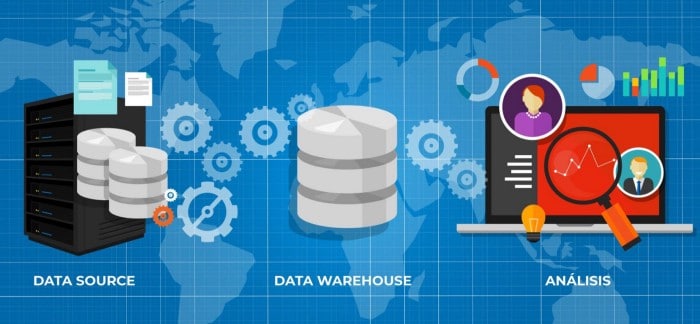
What is known as Data Warehouse is the traditional Business Intelligence system of the company, one of its properties is that they only allow structured data. It involves much investment because we would have to pay for capacity (since the Data Warehouse has its processing). That is, this was only used in large companies due to the large amounts of investment required.

The Data Warehouse, due to its high costs and that its clusters are for processing as well as much less capacity than a Data Lake could not be scaled to Exabyte.

Although the most significant difference is that in Data Warehouse, the user defines the schema before loading data, that is, you must know and define what is going to be sent before loading it and then be analyzed by another of the tools of Business Intelligence that will show dashboards, visualizations, etc.

It does not mean that the Data Lake will supplant the Data Warehouse, but rather that it comes to complement it in cases where the company or architecture needs it or already owns it and does not want to get rid of it.

Data Warehouse process for further analysis
Data Warehouse process for further analysis.

So then, there are three possible architectures:

  1. That the company already has a Data Warehouse and wants to make a Data Lake. Then it can be done in a complementary way, creating a Data Lake separately and all the data from the Data Warehouse, sending it to the Data Lake and using its tools for Big Data processing, Machine Learning, and other issues; otherwise, it could not apply.
  2. The company does not have a Data Warehouse, one is needed, and a Data Lake because the Business Intelligence tool is to be used. The data engineers only support connections to the Data Warehouse where the data is structured. So what is recommended is to raise the Data Lake and create a separate Data Warehouse where all the data ingestion is done through the first one, in order to be then able to send the information directly to the Data Warehouse already transformed, so that the Business Intelligence tool consume it directly from there. In turn, all the data can be used in Big Data processing and all the tools that Data Lake allows us to use.
  3. Finally, and easier: that only one Data Lake is required. A Data Warehouse would not be needed since the Business Intelligence tool directly supports connections to the Data Lake. You could just lift the Data Lake and do all the Business Intelligence and Big Data processing directly from there.

Data Lake Properties

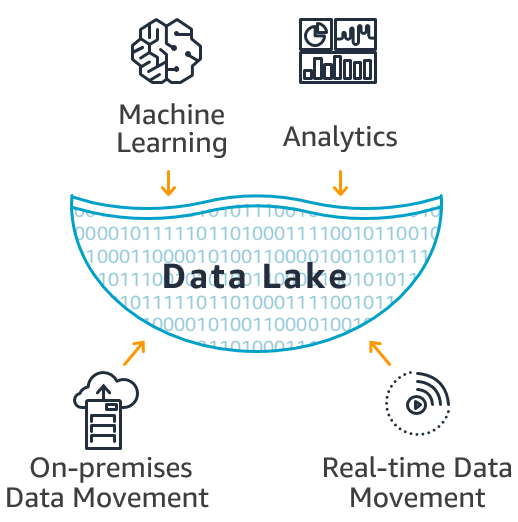
The most important property is that it does not matter where the information is located in an easy, secure way (it travels encrypted) and low cost. Everything can be migrated to a Data Lake: from Premise, from the cloud, from AWS, etc.

In addition to that, other data movements are obtained, which is if the application works real-time, that is, if it is required to send logs of our application, of Twitter tweets to see what the customer thinks of a product and service, it can be done in real-time and thanks to a lot of AWS services.

What is a Data Lake?
What is a Data Lake? Source: AWS

Another possibility is that a company has streaming videos in real-time and wants the application to continue to function normally, streaming videos in real-time and storing them in a Data Lake to be analyzed in real-time.

Once the data is ingested, the important part begins: analyze it, take advantage of the Data Lake, make business decisions that affect the company, improve it, improve its product, etc. Then there are two main branches: Analytics on the data, that is, show them on the dashboard, modify them, show visualizations, extract the information.

The second branch: Machine Learning, to be able to predict a little information. There are AWS services that allow analyzing Machine Learning, especially to companies that have experts in this subject, and services that allow small or medium-sized companies not to hire an expert in Machine Learning. For example, AWS Comprehend allows you to understand a bit of natural human language and transform that into ideas: understand what specific tweets are saying, know if they are evaluating it positively, negatively, or neutrally, etc. There are services like Recognition to recognize faces or objects in, for example, a live stream. This is a great advantage today because it allows small and medium-sized companies to have a Data Lake and exploit it without significant investment.

We are often asked in DinoCloud: “how long will my DL be up and running?”. The answer would be no more than two weeks, using what is recommended with essential functions initially, exploiting the data a little, seeing what the company needs, and making dashboards, visualizations, and Machine Learning.

Another common query is: “Would the development of a Data Lake affect my Application / Service that is running in the cloud?”. The answer is simply no. They are entirely complementary questions, in parallel. An application can continue to be developed by performing a Data Lake in parallel without disturbing or the performance being low at those moments in the application. It is because requests are not made directly to the database that the application is using. However, they apply Amazon services that allow extracting all that information from a database-type backup, doing it with the Read Replica, for example, without affecting the application and at a low cost.

AWS SERVICES

S3

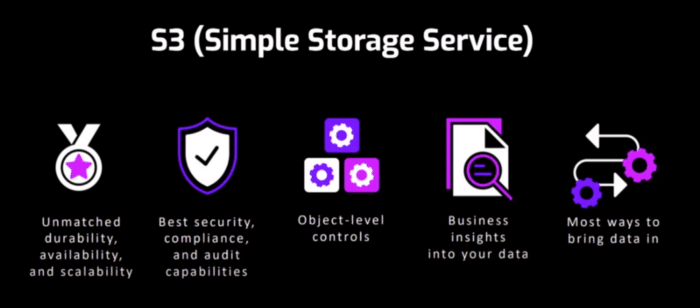
Where do I keep the data, where do I store it, what would my Data Lake be? The answer is Simple Storage Services (S3). It is a storage of objects in Amazon. It is virtually unlimited, meaning that you can load as many exabytes as you need. It has an availability of 99.99%, which allows us to know that all our data will remain safe there, and any disaster or inconvenience that may occur, the data remains backed up. Being Amazon’s first cloud service, it is pretty polished and has much power, a lot to give, and all Amazon services are integrated with S3. This is the most important “why” of choosing S3 as a data storage for a Data Lake. It is also self-scalable, and it only charges for what it is used; it does not pay more.

Another of its main characteristics is security: you can block the permissions to other users, the only ones who can access this data are Amazon services, and you must pass through them to be able to see the data, in addition to being able to encrypt the data. Information through KMS (Key encryption service). You can also control the properties of the object at the object level itself, being able to make it public, for example, a single file within an entire bucket without having to make the entire bucket public.

S3 Specific properties
S3 specific properties.

One of the essential properties of S3 is the number of services that allow you to enter the data as needed. That is to say, it allows to unify of all the dispersed data (in a cloud, on-premise, etc.) in a Data Lake.

In terms of costs, S3 only charges for what is used and no more. These costs are tied to how frequently the user accesses the data that is in S3. S3 Standard has an estimated price of $ 0.0210 per GB.

S3 Standard IA (Infrequently Accessed Data) is next to S3 Standard. For less frequently accessed data, its price is reduced by almost 40%, and it has the same properties as the S3 standard. It is found in 3 availability zones, and it is available all the time; it has milliseconds of access. However, Amazon charges a small percentage of commission per Giga that is extracted, so each time you want to access the data, it will charge a small commission per object that is being requested.

By way of mention, there is also the S3 One Zone IA, which is the same as the S3 Frequently Access with the difference that it is found in an availability zone, with high availability and is generally used for backups. There are also S3 Glacier services, where access to data takes minutes or hours, and S3 Glacier Deep Archive, where there is a delay of 12 to 48 hours to access. These are used for data accessed once or twice a year, and the cost is extremely cheap.

How is the data ingested in a Data Lake? Here are some Amazon services that can be used to enter data:

  • AWS Direct Connect: allows you to segment and securely send all the data that does not pass through the internet. It is recommended for large amounts of data.
  • Amazon Kinesis: for streaming data and video
  • Amazon Storage Gateway: virtual connection between Amazon and an On-Premise. Allows file transfers safely and with all the properties.
  • Amazon Snowball: commonly used for physical migrations. Scalable up to Terabyte.
  • AWS Transfer for SFTP: raises SFTP servers and can be used through a VPN.

Kinesis

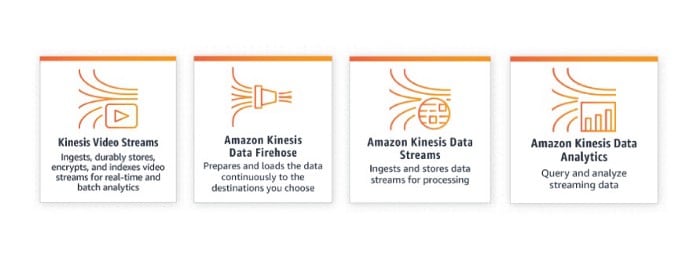
It is a real-time service from Amazon. It is divided into four sub-services:

  • Kinesis Video Stream that streams live videos allows that while the stream pipeline is being maintained, the data can be ingested to S3 in real-time or doing analytics on this video.
  • Amazon Kinesis Data Firehose allows data ingestion in ‘near real time’ to S3, Redshift, etc. If an application is sending events or logs all the time, it allows to ingest the data continuously and in ‘near real time’ to S3, ElasticSearch or Redshift.
  • Amazon Kinesis Data Stream that allows real-time data streaming but is usually used more to send data to applications, directly to an EC2 to be processed, and is responsible for sending it directly to Amazon Kinesis Data Analytics
  • Amazon Kinesis Data Analytics, real-time analytics that allows you to query the data that is passing live.
4 Kinesis sub-services
4 Kinesis sub-services. Source: AWS.

An essential property of Kinesis is that it is Serverless; you pay only for what you use.

AWS Glue

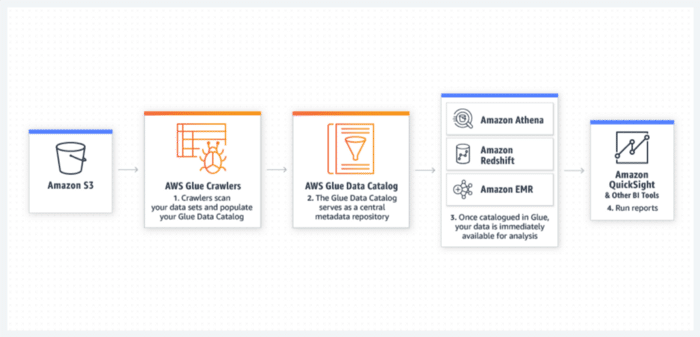
How to consume data from a Data Lake? This answer will begin by talking about AWS Glue. It is an Amazon service with two main parts, Data Catalog, where all the data is cataloged, and all the metadata is obtained and stored there. It allows a Data Lake to be kept organized so that other services can later consume it. It is crucial to have a data catalog. In turn, Amazon Glue has a service called Crawler, which allows the metadata of all the data to be extracted automatically and serverless. A Crawler is created, all metadata is extracted, and you are charged for the minutes it took the Crawler to extract that data. The data store can be S3 or any other storage. This catalog is saved in the Data Catalog part of Amazon Glue, in the form of a database, which shows a table with all the necessary information registered. The formats supported by crawlers are CSV, AVRO, ION, GrokLog, JSON, XML, PARQUET, GLUE PARQUET.

Queries in an Amazon S3 Data Lake

The second part is ETL, significant in the world of Data Lake and Big data, which is the part where all the data is extracted from the Data source, transformed employing a script running in an engine, and then loaded transformed to a target. This does not mean that the Data Source and the Data Target are different, but they can be the same.

Allowed Data Source and Data Target are Amazon S3, RDS, Redshift, and JDBC connections.

AWS Glue Jobs is a service that allows you to run a script on a serverless server. You can add a trigger in this; every time there is a file in S3, a trigger is automatically performed. However, the data must be cataloged to use Job since tables can only be created after being cataloged. For example, if you go from an S3 to a Redshift, the metadata must be present to create Redshift tables. Otherwise, it must be done manually. Then the Job procedure is as follows

  • extract the data,
  • perform a trigger in any way (on-demand or by a specific trigger),
  • extract the data from the source,
  • run a script that transforms the data, and
  • return them to carry.

It is essential to know; it is not necessary to know how to program in Python to run the script because Amazon offers the possibility of specifying the transformations that you want to do and writes the script automatically. If a modification is required, the script is available for modification. It is one of the main advantages of Amazon Glue Jobs.

AWS Athena

Another way to consume data from a data lake is AWS Athena. It is an Amazon service that allows me to query the data with SQL queries directly to S3. It is a serverless service. The queries have a performance to process the data at high speed and with fast configuration. Just go to the Amazon Athena console, indicate what data to analyze, and start writing. However, it is necessary to have the data cataloged, or it can be done by hand. You only pay for scanned data. If 1Gb is explored in a query, it will be charged only for 1Gb.

Amazon Athena allows from anywhere, for example, a business intelligence tool that needs to consume data from S3, make the connection, and perform the S3 query. So the Business Intelligence tool where all the dashboards will be displayed has a connection and processing capacity of bringing the data without the need to move all of these to a Data Warehouse.

Amazon RedShift logo

AWS Elastic Map Reduce

Finally, we will talk about Amazon EMR (Elastic Map Reduce). It is Amazon’s service par excellence in Big Data. It allows to deploy all the applications for all the Open Source frameworks, like Apache Spark, Hadoop, Presto, Hive, and others; it allows you to configure everything in cluster mode. It is self-scalable with high availability. It is vital because there are situations in which a large amount of data needs to be processed at a particular time, so you only charge for that time used, and you save much money. It is a Multi-Availability Zone, and it has data redundancy, and in any situation that happens, everything will remain up and available to the user. It is easy to administer and configure since it does so automatically by going to the console and raising the desired frameworks, indicating the number of nodes required, what types of nodes, and others. Amazon EMR is tightly integrated with Data Lake and all of the services listed above.

After processing all the data and ingesting it, now comes the part that business people are most interested in. The Business Intelligence service is called Amazon QuickSight. It is the first Business Intelligence service that pays per session. In other words, you will only pay each time you enter the QuickSight console, not by users, not by licenses, only by session. There are two types of sessions as in all Business Intelligence: the creator, the user who exploits the data, and the person who views the data to make decisions.

At DinoCloud, we take care of turning a company’s current infrastructure into a modern, scalable, high-performance, and low-cost infrastructure capable of meeting your business objectives. If you want more information, optimize how your company organizes and analyzes data, and reduce costs, you can contact us here.

Francisco Semino

Francisco Semino

Lead Solutions Architect
@DinoCloud


Social Media:

LinkedIn: https://www.linkedin.com/company/dinocloud
Twitter: https://twitter.com/dinocloud_
Instagram: @dinocloud_
Youtube: https://www.youtube.com/c/DinoCloudConsulting

Categories
Data Analytics

Decisions taken from data analysis give a very high rate of effectiveness to companies

Analyzing Data

Among other things, it will be possible to know what is needed to improve from previous events.

Written by William Díaz Tafur

Data analysis is vital for companies because, from this point on, it will give the answers that the business needs to be able to innovate in any area.

Furthermore, it is that the determinations taken from the data give a very high rate of effectiveness. In this way, it will be possible to know what is needed to improve from previous events, since it is not the same to make a decision blindly or guided by instinct as one taken from data obtained from the previous operation.

To carry out operations.

On the other hand, the data can be used in an application that works automatically in the performance of operations and in which, based on previous situations, it makes the decision itself or in the visualization step, it can be used to that a person look at them and make decisions from them.

Similarly, the hypotheses or theories raised by companies in their business area are validated with the results of the more or less intelligent analysis of the data they already possessed or are beginning to process thanks to data engineering.

Uses and tools

The most common uses are log analysis, e-commerce personalization or recommendation engines, fraud detection and financial reports, among many others.


Moreover, if we refer to tools for data analysis, some depend on the type of analysis needed. The best known are the Apache frameworks for big data, or they can be used on AWS in the EMR service.

Machine Learning

In data analysis, there is also what is known as machine learning techniques, which allow a “machine” to learn from the past data for the analysis of current information.


For example, being a company dedicated to electronic commerce, a machine learning model can be trained so that, given a transaction, it says whether it is fraud or not.


This model, previously trained with the historical transaction data of the business and the more data from the past it has, the more effective it is and, in turn, it learns the more it is used.


Social Media:

LinkedIn: https://www.linkedin.com/company/dinocloud
Twitter: https://twitter.com/dinocloud_
Instagram: @dinocloud_
Youtube: https://www.youtube.com/c/DinoCloudConsulting